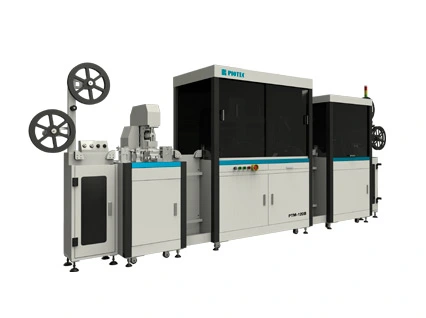
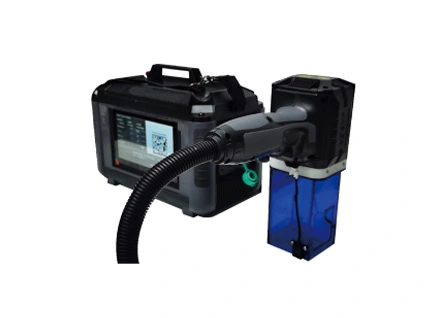
an M2M chip personalization machine like the SCM300 can directly boost IoT security and operational efficiency by combining electrical testing, secure encoding, verification, and laser marking into a single automated flow, reducing human handling while improving traceability and yield. For IoT at scale (eSIM, automotive SE, industrial devices), personalization is where security becomes real - or where it breaks.
IoT deployments are growing fast, but so is the attack surface. The SIM/eSIM or security element is often the device’s root of trust: it stores identities, keys, and operator profiles that determine whether a device can authenticate, connect, and update securely.
That means personalization is not just programming. It’s the moment where sensitive credentials are injected and must be:
written correctly the first time
protected from leakage during handling and data exchange
verified with strong process controls
linked to a trackable production record for audits and recalls
Any weakness here can become a fleet-wide vulnerability. This is exactly why manufacturers and mobile operators are moving toward automated, high-throughput, closed-loop personalization equipment rather than fragmented stations and manual checkpoints.
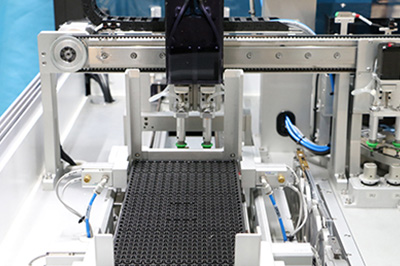
Piotec’s SCM300 M2M Chip Personalization Machine is built for high-speed, stable, and secure personalization production for global mobile operators, smart device OEMs, and automotive electronic security chip manufacturers. It supports multiple packaging forms including QFN, DFN, VSOP-8, plus applications such as automotive SE (Security Element), eSIM, and other smart devices.
In practice, SCM300 covers the key stages that drive both security and efficiency:
Chip electrical performance tests (catch issues early)
Chip encoding (secure data injection / key provisioning workflows)
Surface laser marking (traceable identifiers and anti-tamper marking)
Since 2017, SCM300 machines have reportedly supported personalization of roughly 500 million chips, which is a strong signal of maturity in real-world factory conditions.
SCM300 supports tray and tape workflows, which matters because factories rarely run a single packaging format forever.
Tray input/output: up to 20 trays
Tape input support: 12mm standard (8/16/24mm extensible)
Tape roll compatibility: 100pcs and 300pcs
This reduces changeover friction when you’re personalizing different SKUs for different customers.
The SCM300’s IC Perso module is designed for parallelism:
Standard: 16 personalization stations with 4 Piotec 4-in-1 contact readers
Expandable: 32 stations with 8 readers
Supports multiple protocols: ISO7816, Serial, Bluetooth, SPI, I2C
It also supports online encoding and re-making, which is crucial when you need controlled rework without breaking compliance processes or losing traceability.
Security isn’t only about cryptography; it’s also about process evidence.
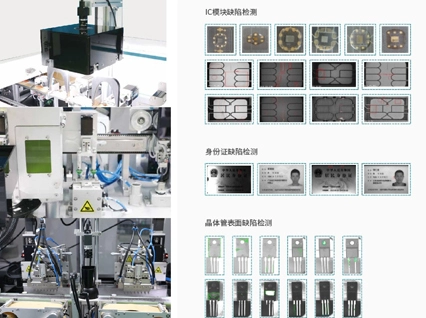
IC verification module reads and verifies two chips simultaneously, aiming at 100% accuracy
OCR verification uses a 5MP industrial camera (with light source) to validate markings/visual identifiers
This is how you reduce “silent failures” - chips that appear fine until they fail in the field.
The laser marking module includes:
20W fiber laser
extractor system
ability to mark two chips at the same time
Laser marking supports traceability (batch/UID/2D codes), helps anti-counterfeiting, and creates a durable ID layer that survives harsh industrial or automotive environments.
The SCM300 includes 8 reject boxes, automatically sorting chips that fail encoding or marking into categories. That reduces material loss and prevents mixed inventory - an underrated risk in secure provisioning environments.
Key published specs:
Capacity: 2,500 UPH
Throughput potential: 1,300,000 chips/month
Noise: <65 dB
Networking: Ethernet
Stability claims: rejecting rate < 1/100, and downtime for 100-hour failure ≤ 30 minutes
Changeover: supports many chip forms; switching time < 20 minutes
In IoT programs, the hidden cost is often not the machine - it’s line stoppages, rework, and the operational drag of switching between projects. High compatibility plus fast changeover is what keeps delivery dates intact.
Many IoT deployments still rely on SIM supply chains, and eSIM growth increases personalization complexity rather than reducing it. Piotec’s broader SIM Card Manufacturing and Issuing Solution covers:
SIM card system processes (card body matting, milling slot package, back glue, half card, four card matting)
personalized distribution (chip pre-personalized data, read/write, laser marking)
a Production Management System (unified process management, real-time monitoring, equipment status, spare parts)
That Production Management System is the part that factories often underestimate: it turns line data into decisions - reducing waste, catching anomalies earlier, and lowering SIM manufacturing cost systematically.
For buyers comparing sim cards wholesale suppliers, the operational maturity behind the supply chain matters as much as the per-unit price. A supplier with real-time production monitoring and controlled personalization processes is less likely to ship inconsistent batches or miss compliance requirements - two problems that can quietly destroy margins in high-volume IoT connectivity programs.
If you’re provisioning chips for IoT connectivity or automotive-grade security elements, SCM300 is positioned to deliver:
higher security via closed-loop encoding + verification
higher efficiency via 2,500 UPH automation and fast changeovers
higher traceability via laser marking + OCR/IC verification
lower operational cost via automated reject sorting and stable uptime
In short: it’s not only a personalization machine - it’s a production reliability tool for security-sensitive IoT supply chains.
Q: What is an M2M chip personalization machine used for?
A: An M2M chip personalization machine is used to test, encode (provision), verify, and mark chips such as eSIM, automotive security elements, and IoT connectivity modules - so each chip leaves the factory with the correct identity and security data.
Q: How does SCM300 improve IoT security?
A: SCM300 improves IoT security by automating sensitive steps like chip encoding and verification, reducing manual handling, and adding traceability through laser marking and OCR/IC verification - helping ensure credentials are correctly written and auditable.
Q: What chip packages does the SCM300 support?
A: The SCM300 supports common M2M packaging forms including QFN, DFN, VSOP-8, and other package types used in eSIM, automotive electronic SE (Security Element), and smart device chips.
Q: What is the throughput of SCM300?
A: The SCM300 is rated up to 2,500 units per hour (UPH) and can reach roughly 1,300,000 chips per month depending on production scheduling and configuration.
Q: Why is laser marking important for eSIM or security element production?
A: Laser marking provides durable, tamper-resistant identifiers for traceability, quality control, anti-counterfeiting, and after-sales investigation - especially important in regulated or high-reliability IoT sectors like automotive.
Q: How should I evaluate sim cards wholesale suppliers for IoT projects?
A: Beyond pricing, evaluate whether the supplier has secure personalization capabilities, verification controls, traceability, and production management systems (real-time monitoring and process control). These directly impact batch consistency, compliance, and delivery risk.

Contact Piotec for Smart Card Solution