A secure card must protect personalized information, resist tampering, and remain legible during daily use. This is why laser engraving is widely considered for government IDs, access cards, selected banking cards, and other secure documents.
A laser card engraver uses a controlled laser beam to mark information directly onto or within a compatible card body. Unlike surface printing that depends on ink, ribbon, or transferred film, laser personalization changes the card material itself. The resulting text, images, codes, and security effects are durable and difficult to remove without leaving visible damage.
Choosing a machine is not only about image quality. Material, encoding, capacity, inspection, software integration, and traceability all matter.
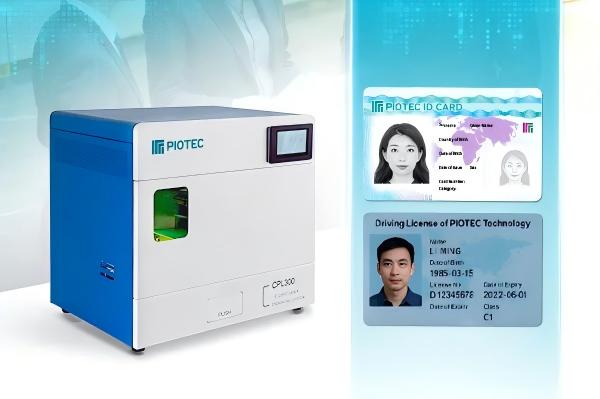
A laser card engraver directs a focused beam across a defined area according to a digital personalization file. The laser interacts with the material to create names, photographs, serial numbers, barcodes, machine-readable elements, or security graphics. The result depends on the laser source, material, power settings, and optical configuration.
Polycarbonate is commonly used for high-security laser-personalized cards because information can be created within the card structure rather than only on the surface. Other materials may also be processed when they are compatible with the selected laser.
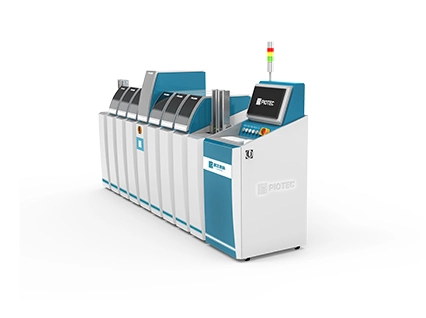
PIOTEC states that the CPL300 supports ISO ID-1/CR-80 cards made from PC, PET, PVC, ABS, and other compatible materials. Every project should still validate the final result using the actual production card.
A complete system may combine feeding, alignment, encoding, engraving, inspection, sorting, and result recording. It therefore becomes part of a controlled workflow.
The main advantage is permanence. When personalized information is formed in the card material, it is more resistant to abrasion, moisture, handling, and unauthorized alteration than many surface-printing methods. Attempts to remove or replace the information may visibly damage the card.
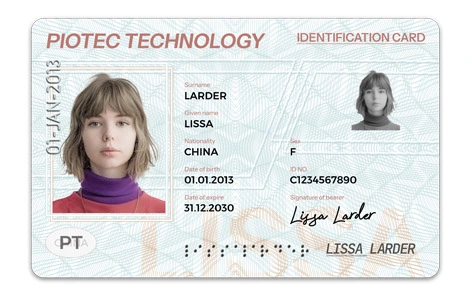
Laser engraving also supports fine text, grayscale portraits, tactile features, and variable graphics generated from cardholder data.
For credit and banking cards, it may support selected visible or tactile features, depending on the material, issuer design, and production line. It does not replace encoding or final verification.
PIOTEC describes the CPL300 as producing card information and anti-counterfeiting effects through laser etching without consumables for those laser-marked elements.
| Personalization Need | Laser Engraving Output | Practical Value |
|---|---|---|
| Cardholder identity | Names, portraits, numbers | Links the card to an approved record |
| Anti-tampering | Permanent material marking | Makes alteration easier to detect |
| Fine security detail | Microtext and complex graphics | Increases reproduction difficulty |
| Machine-readable data | Barcodes and QR codes | Supports verification and tracking |
| Tactile identification | Raised or recessed effects | Adds a feature checked by touch |
| Traceability | Variable serial and batch data | Supports release control |
Available features depend on the machine, software, card structure, and approved design. Common options include high-resolution portraits, microtext, ghost images, tactile characters, variable graphics, barcodes, QR codes, and changeable or multiple laser images.
A ghost image provides a smaller secondary portrait. Microtext places very small characters in a security zone. Tactile effects create a feature that can be felt as well as seen. Changeable or multiple laser images display different information depending on the viewing angle and card construction.
Each feature needs a clear verification purpose. A balanced design should support checks by staff, equipment, and issuing authorities without reducing readability.
PIOTEC lists ghost images, microtext, tactile effects, CLI/MLI, VIPhoto, and DataScreen among the CPL300’s supported security functions. The machine uses a 20 W fiber laser, offers engraving resolution up to 1200 dpi, and includes XY automatic positioning.
Manufacturers should test every effect on production-grade cards because material and card structure can affect the result.
First, confirm support for the actual card material and design. Manufacturers should provide blank cards, artwork, personalization fields, and required security effects before approval.
Next, review data and encoding requirements. Secure cards may need magnetic-stripe writing, contact-chip encoding, contactless encoding, or several technologies on one card.
The CPL300 integrates magnetic-stripe, contact IC, and contactless smart-card encoding, allowing visible and electronic personalization to be handled in one workflow.
Key evaluation points include:
Required production capacity
Single-side or dual-side engraving
Camera positioning and visual inspection
Reject handling and sorting
Database and software integration
User permissions and audit logs
Maintenance and technical support
PIOTEC specifies an input hopper capacity of 200 cards and an output capacity of 150 cards for the CPL300. It also identifies the system as a Class 1 laser product with CE certification.
These figures support initial evaluation, but actual production performance should be confirmed against the card design and process.
In a secure production environment, the system should receive approved data, identify the correct blank card, complete electronic encoding, engrave visible information, inspect the result, and direct passed or failed cards to controlled destinations. Each step should create a traceable status.
Vision positioning helps place information correctly when cards contain preprinted graphics, chips, windows, antennas, or security backgrounds.
Inspection should compare physical and electronic information. A portrait and document number may look correct while the chip contains the wrong record. Conversely, encoding may succeed while visible personalization is incomplete.
Coordinated verification reduces the risk of issuing a card whose internal and external information does not match. It also helps manufacturers identify where an error occurred and whether the affected card should be reprocessed or securely rejected.
PIOTEC develops equipment for card manufacturing, personalization, issuance, visual identification, and testing. Manufacturers can review its smart card manufacturing and personalization equipment to compare laser engraving with banking-card, SIM-card, chip-module, and inspection solutions.
PIOTEC states that its systems combine industrial readers, vision recognition, laser marking, hardware, and application software for integrated workflows.
A laser card engraver is a strong option when a card program requires durable personalization, detailed portraits, variable security features, and visible evidence of tampering. Its value is highest when engraving is integrated with encoding, positioning, inspection, traceability, and secure data management.
The right system must be selected around the card material, security design, capacity target, and approval process. Manufacturers should validate real cards and data rather than relying only on general specifications.
For a configuration review, share the card material, artwork, engraving fields, encoding method, and expected production volume through the PIOTEC contact page. The team can assess whether the CPL300 or another personalization solution better matches the project.
Yes, when the material, design, and production requirements are compatible. Banking cards may also require separate chip, magnetic-stripe, application, and verification processes.
The laser-marked information does not require ink or ribbon. Other modules, such as color printing or hot stamping, may still use consumables.
PIOTEC lists PC, PET, PVC, ABS, and other compatible ISO ID-1/CR-80 card materials. Sample testing is recommended before final configuration.
Provide the card material, artwork, engraving fields, security features, encoding requirements, expected capacity, and inspection needs.

Contact Piotec for Smart Card Solution