For identity card manufacturers, biometric security is no longer an optional upgrade. National ID programs, electronic driver licenses, social security cards, healthcare cards, employee credentials, and border-control documents increasingly rely on verified biometric data, durable physical personalization, and interoperable chip encoding. The challenge is not only to print a card that looks official. The real challenge is to produce a credential that connects a person, a biometric template, a secure chip, and a tamper-resistant physical document in one controlled workflow.
That is where modern ID card personalization machines become essential. A high-security personalization system helps manufacturers transform approved identity data into a finished credential by combining laser engraving, contact and contactless chip encoding, magnetic stripe encoding, optical positioning, visual verification, and anti-counterfeiting features. When properly integrated, these capabilities support biometric security standards from enrollment.
PIOTEC designs smart card manufacturing and personalization equipment for secure credential production, including the CPL300 ID Card Laser Engraving Machine and broader Smart Card Personalization and Issuing Machine solutions. For identity card manufacturers serving government, financial, telecom, enterprise, and public-service programs, the right personalization line can improve security, consistency, throughput, and long-term credential durability.
Biometric standards focus on the quality, formatting, storage, and interoperability of biometric identifiers such as facial images, fingerprints, and iris data. In practical ID card manufacturing, this means the physical credential and its electronic data must remain aligned. For example, NIST SP 800-76-2 describes biometric specifications for Personal Identity Verification credentials, including acquisition and formatting requirements for fingerprint, iris, and facial data. The ISO/IEC 19794 series addresses biometric data interchange formats, helping systems exchange biometric information in a standardized way. For travel documents and certain official ID formats, ICAO Doc 9303 guides the machine-readable travel document standard and the deployment of biometric identification and electronic data storage.
Although these standards are not all applied in the same way for every national ID, employee badge, or driver license program, they point to a common
manufacturing requirement: the card personalization process must preserve data accuracy, support secure storage, and create physical security features
that make tampering difficult.
For identity card manufacturers, that translates into five production needs:
- Accurate personalization of visible identity data, including portrait images and demographic fields.
- Secure chip or magnetic encoding that matches the approved holder record.
- Durable marking methods that resist abrasion, alteration, and chemical attack.
- Visual and electronic verification before cards leave the production line.
- Traceable issuance workflows that reduce operator error and unauthorized handling.
An ID card personalization machine is the point where digital identity data becomes a physical credential. In a biometric ID workflow, the machine receives
approved cardholder data, applies visible personalization, writes electronic data, and verifies output quality.
In lower-security card programs, personalization may be limited to surface printing. But biometric credentials require stronger controls. Portraits may need
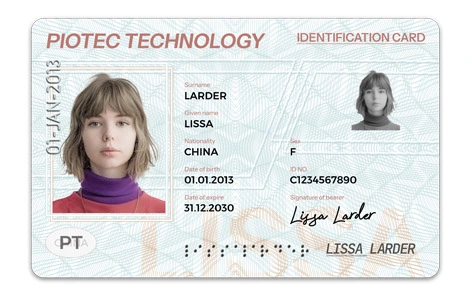
to be laser engraved into polycarbonate or other secure card materials. Ghost images, microtext, tactile information, and CLI/MLI features can be added to
make the credential more resistant to copying. Chip data must be encoded with precision so inspection systems, access-control systems, or issuance authorities can read and validate it.
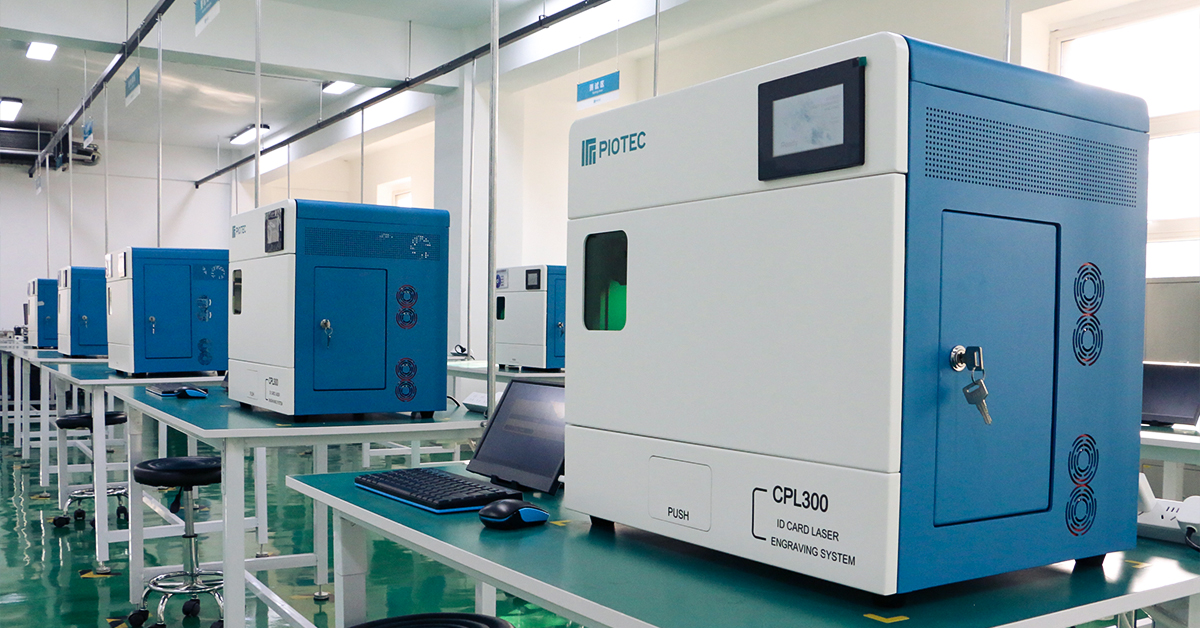
PIOTEC’s CPL300 ID Card Laser Engraving Machine is designed for government-grade secure ID documents, including national ID cards and driver’s licenses. According to PIOTEC product information, the system integrates magnetic stripe, contact IC, and contactless RFID encoding with laser engraving
up to 1200 dpi. It also supports security features such as ghost images, microtext, tactile effects, and CLI/MLI, making it suitable for high-security ID card
personalization.
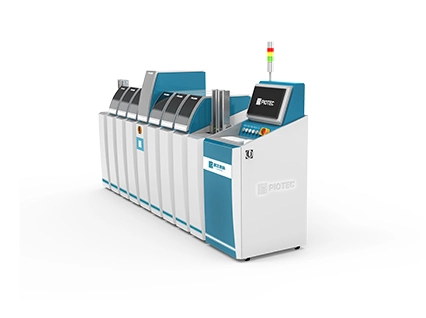
For projects that require wider card issuance capability, PIOTEC’s Smart Card Personalization and Issuing Machine category includes equipment for ID cards, SIM cards, social security cards, banking cards, sorting, ranking, and flexible card personalization lines.
Laser engraving is one of the most important technologies for biometric credential security. Instead of placing information only on the surface of the card, laser personalization changes the card material itself. This creates a durable mark that is difficult to remove or replace without damaging the credential.
For biometric ID cards, laser engraving helps protect:
- The cardholder portrait.
- Name, date of birth, document number, and other visible identity fields.
- Secondary portrait features such as ghost images.
- Fine security details such as microtext and tactile elements.
- CLI/MLI effects that reveal different images or data when viewed from different angles.
This matters because the visual face of the card remains one of the fastest checks in real-world inspection. Border officers, public-service staff, security guards, and enterprise administrators often compare the holder with the portrait before using electronic verification. A high-resolution laser-engraved portrait helps reduce the risk of photo substitution, surface tampering, and counterfeit reproduction.
PIOTEC’s CPL300 supports ultra-fine laser engraving up to 1200 dpi and is positioned for secure ID documents where clarity, durability, and anti-counterfeiting performance are central requirements.
Biometric security depends on more than a printed portrait. Many modern credentials store biometric references, cryptographic data, or application-specific identity data in a contact or contactless chip. This is why chip encoding is a critical part of secure card personalization.
A capable ID card personalization machine can encode data into multiple technologies, including contact IC cards, contactless smart cards, RFID cards, and NFC-compatible credentials. The encoded data must match the visible card information and the back-end issuance record. If the portrait says one thing and the chip says another, the credential fails both security and operational expectations.
For identity card manufacturers, integrated encoding reduces the need for separate manual steps. When data encoding, laser engraving, and inspection are handled in one controlled process, the risk of mismatch is reduced. It also helps manufacturers scale production while maintaining consistent quality.
PIOTEC’s CPL300 includes a data personalization module supporting magnetic stripe, contact IC, and contactless smart card encoding. For high-volume or multi-application projects, PIOTEC’s FPL3000 Banking Card Flexible Perso Line demonstrates the company’s modular approach to personalization lines, with configurable modules such as magnetic encoding, contact IC encoding, contactless IC encoding, thermal printing, embossing, laser engraving, optical visual verification, and chip verification.
Biometric standards are built on trust in data quality. If a personalization line produces a card with a wrong portrait, unreadable chip data, incorrect document number, or poor engraving quality, the entire credential loses trust.
This is why visual inspection and verification systems are important in secure ID card manufacturing. A vision system can support alignment, positioning, and quality control. Optical verification can compare finished output against expected card data, helping catch defects before cards are delivered.
In biometric ID issuance, verification may include:
- Portrait placement and clarity.
- Text accuracy and legibility.
- Barcode, MRZ, or document-number readability where applicable.
- Chip read/write confirmation.
- Contactless interface verification.
- Surface defect inspection.
- Rejection of cards that fail defined quality thresholds.
The result is not only better quality, but also better auditability. For programs involving public identity, finance, healthcare, telecom, or enterprise access, a repeatable inspection workflow helps identity card manufacturers prove that production controls are in place.
A biometric credential is only as secure as the process that creates it. Even when the card body, chip, and biometric template are secure, weak manufacturing controls can create risk. Unauthorized data access, card mix-ups, untracked rejects, and manual rework can undermine an otherwise strong ID program.
Modern personalization equipment supports secure issuance by reducing manual handling and consolidating critical steps. Input hoppers, encoded data modules, laser engraving modules, rejection bins, verification modules, and output hoppers can work together to maintain a controlled card flow.
PIOTEC’s CPL300 includes a high-capacity input hopper and output hopper, data encoding, XY auto-positioning, laser engraving, and physical/electronic security features. Its modular structure allows configurations based on customer requirements, which is useful for identity card manufacturers that need to support different credential programs, card materials, or security policies.
For larger issuance environments, a configurable personalization line can be designed around the project’s required throughput, verification steps, encoding methods, and physical security controls.
Different ID programs have different security profiles. A national ID card may require long-life polycarbonate laser engraving, contactless chip encoding, biometric data support, CLI/MLI, and strict inspection. A corporate ID may emphasize access-control compatibility and fast issuance. A social security or healthcare card may require strong data integrity, cardholder privacy, and multi-application chip support.
Modular personalization equipment gives manufacturers flexibility to match these requirements without rebuilding the entire production workflow. Depending on the project, modules may include:
- Laser engraving.
- Dye sublimation or DOD printing.
- Magnetic stripe encoding.
- Contact IC encoding.
- Contactless IC encoding.
- RFID/NFC personalization.
- Embossing, indenting, and topping.
- Optical visual verification.
- Contact and contactless chip verification.
- Sorting, ranking, and reject handling.
This modularity is especially valuable for identity card manufacturers serving multiple customers or government tenders. A flexible platform can support today’s project while leaving room for future biometric requirements, additional card materials, or higher security features.
For government ID programs, personalization machines help support document integrity, citizen trust, and long-term lifecycle durability. Laser engraving and chip encoding can make credentials more resistant to counterfeit attempts, while inspection systems help reduce issuance errors.
For commercial programs, the same technologies can support secure employee badges, transportation cards, campus credentials, healthcare cards, financial cards, and membership cards. As biometric authentication becomes more common in access control and identity verification, manufacturers that can deliver secure and interoperable credentials will be better positioned for high-value projects.
Key benefits include:
- Stronger protection against photo replacement and data tampering.
- Improved durability for long-validity credentials.
- More accurate matching between printed, engraved, and encoded data.
- Better readiness for biometric and smart-card standards.
- Scalable production for high-volume issuance.
- Lower operational risk through automated verification and controlled handling.
When evaluating equipment, identity card manufacturers should look beyond basic print speed. The right system should match security requirements, card material, application type, and integration needs.
Important evaluation criteria include:
- Support for required card materials, such as PC, PET, PVC, or ABS.
- Laser resolution and engraving quality.
- Contact, contactless, RFID, NFC, and magnetic encoding compatibility.
- Support for anti-counterfeiting features such as ghost images, microtext, tactile effects, and CLI/MLI.
- Vision positioning and verification capability.
- Secure card input, reject, and output management.
- Modular configuration for future expansion.
- Compatibility with the customer’s issuance software and data workflow.
- Supplier experience in secure card manufacturing and personalization projects.
PIOTEC’s portfolio covers smart card manufacturing, personalization, testing, issuing, sorting, ePassport production equipment, and related systems. This makes PIOTEC a practical partner for organizations looking to build or upgrade secure ID card production environments.
Biometric security standards are raising expectations for how identity documents are produced. The future of ID card manufacturing is not simply about printing faster. It is about producing credentials that are durable, verifiable, interoperable, and resistant to manipulation.
PIOTEC helps identity card manufacturers meet these demands with personalization systems that combine laser engraving, data encoding, modular configuration, and verification-oriented production. Whether the project involves national ID cards, driver licenses, social security cards, healthcare cards, employee badges, or other secure credentials, PIOTEC can help design a solution around the required security level, card type, and production volume.
Planning a biometric ID card project or upgrading an existing issuance line? Contact PIOTEC to discuss your card material, security features, biometric data requirements, encoding methods, production capacity, and verification workflow.
Get your tailored ID card personalization solution from PIOTEC today: Contact PIOTEC

Talk to a Card Personalization Expert