In the rapidly accelerating digital landscape, the security of our interconnected world relies entirely on the robust, fail-safe performance of Secure Elements (SE). From the automotive electronic security chips that power autonomous vehicle safety to the eSIMs embedded in our smartphones and the highly sensitive sensors in the Internet of Things (IoT), the integrity of these components is the bedrock of modern trust. At the very heart of this high-stakes industrial sector lies the chip manufacturing machine—a sophisticated, technology-driven powerhouse that transforms raw silicon and substrates into the fundamental building blocks of digital security.
A Secure Element is essentially a hardened, tamper-resistant platform—a digital fortress designed to securely host sensitive applications, cryptographic keys, and biometric data. Because these components are tasked with protecting the most private aspects of our digital identity, the manufacturing process leaves no room for error. Precision manufacturing is not merely a production goal; it is a security imperative. Even a microscopic deviation in chip placement, a minor variance in thermal distribution during lamination, or a slight inaccuracy in data writing can render the security features of the chip ineffective.
High-precision manufacturing ensures that the physical and logical integrity of the Secure Element remains uncompromised from the moment it leaves the foundry until it is deployed in the field. When we speak of precision in the context of a chip manufacturing machine, we are referring to the ability to handle miniaturized packaging forms—such as DFN, QFN, SOP, VSOP, and LQFP—with micron-level accuracy. Achieving this level of precision requires a deep understanding of material science, robotics, and high-frequency electronics, ensuring that the hardware foundation of our digital trust is built on absolute perfection.
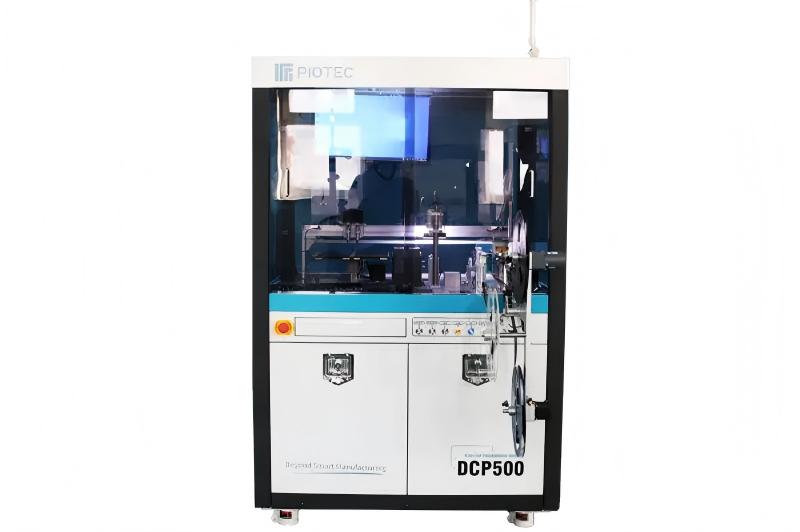
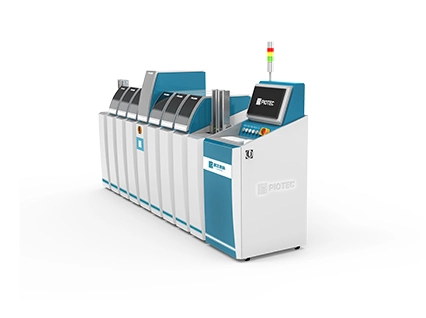
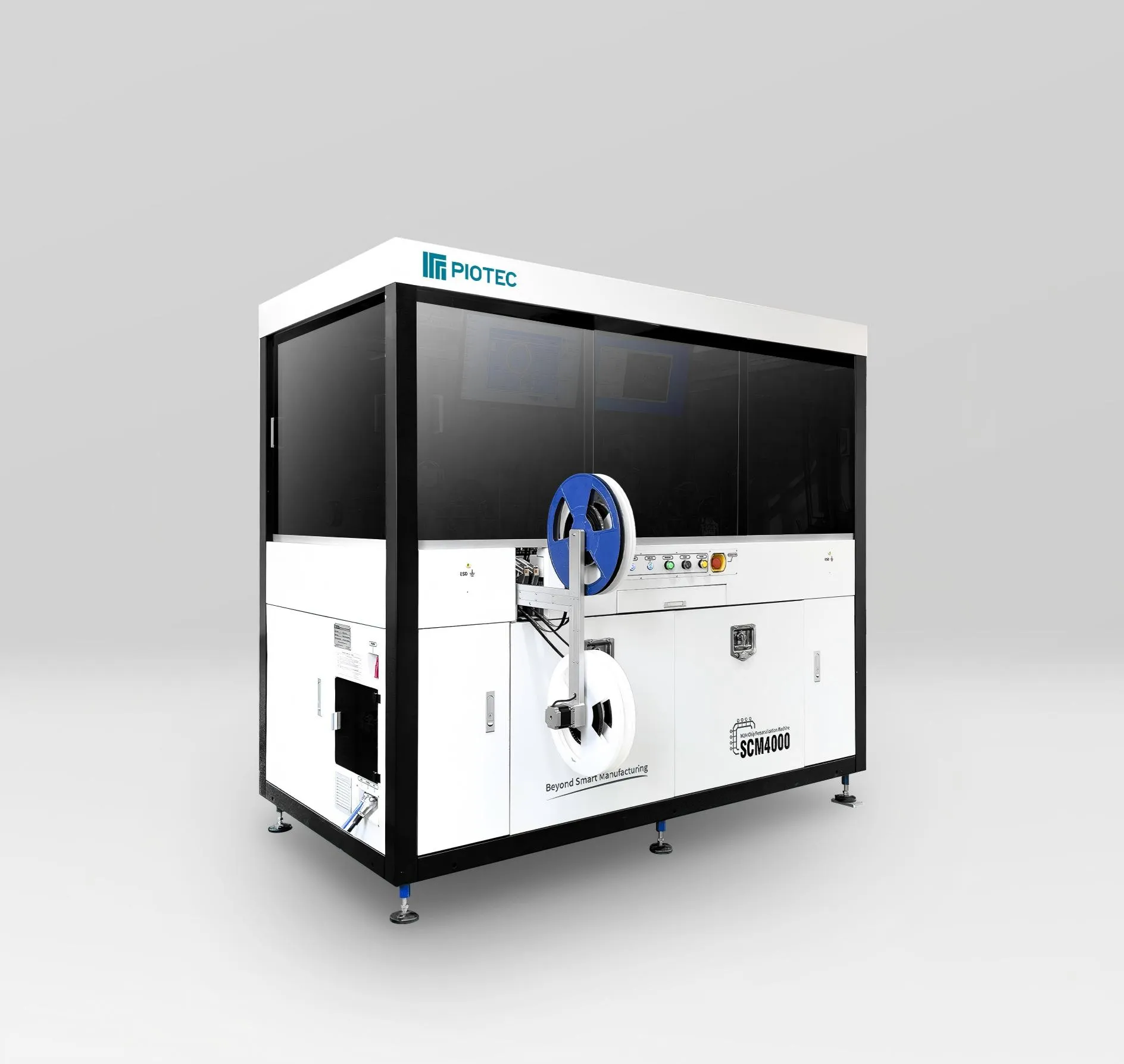
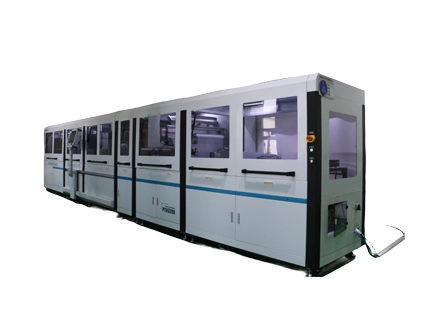
The landscape of Secure Element production is dominated by highly specialized machinery, each optimized for specific stages of the assembly and personalization process. Take, for example, the DCP500, a benchmark chip manufacturing machine in the industry. These machines are engineered to address the complexities of small-batch order production while maintaining the stability required for mass-market deployment. They are equipped with sophisticated robotic arms utilizing vacuum adsorption technology, allowing for the rapid and safe transport of chips across various processing stations.
Beyond simple transport, these machines are integrated with complex feeding units that support diverse delivery methods, including trays and various tape-and-reel specifications (such as 8mm, 12mm, 16mm, and 24mm tapes). This modularity is essential because it allows manufacturers to adapt quickly to the varying physical requirements of different smart devices. The machines also incorporate advanced IC writing units, often featuring high-performance reader-writers that support a wide spectrum of communication protocols, including ISO 7816, serial, Bluetooth, SPI, and I2C. By centralizing these functions into a single system, manufacturers can streamline their operations, reduce the risk of contamination, and maintain a tighter grip on production quality.
In the realm of Secure Element production, reliability is synonymous with security. Advanced chip manufacturing machine systems enhance reliability by integrating multiple critical steps—electrical performance testing, data personalization, and visual verification—into one cohesive, high-speed workflow. When a chip enters the production line, it is not just being assembled; it is being validated.
The personalization phase is where the machine acts as the ultimate gatekeeper. Using highly sensitive, precision reader-writers, the system performs a secure injection of personalized data, ensuring that every unique cryptographic key is correctly and permanently etched into the Secure Element. To prevent any fraudulent or faulty hardware from entering the supply chain, these machines feature integrated waste management systems. If a chip fails the electrical performance test or the laser marking process, the machine automatically diverts it to a secure, locked storage unit. This closed-loop process ensures that no defective components can ever reach an end-user, maintaining the absolute integrity of the security lifecycle.
Automation is no longer a luxury; it is the fundamental pillar of modern semiconductor production. The role of automation is best exemplified by the visual intelligence systems integrated into modern chip manufacturing machine units. Equipped with high-resolution CCD industrial cameras (often featuring 5-megapixel sensors), these machines perform real-time visual recognition of chip Mark points. This technology allows the machine to identify the orientation of each chip and perform automatic rotations—whether 90° or 180°—without the need for a single second of manual intervention.
This automated precision eliminates the possibility of human-induced errors, such as misaligned chips or scratched surfaces, which were common in traditional, labor-intensive environments. Furthermore, automation allows for consistent performance across massive production runs. Whether the machine is processing 1,000 chips or 1,000,000, the quality remains identical. By reducing the reliance on manual labor, manufacturers can lower their overhead costs and significantly increase their throughput, allowing them to meet the surging demand from global mobile operators, automotive manufacturers, and smart card foundries with ease.
Selecting the appropriate chip manufacturing machine is a strategic decision that impacts an organization's competitiveness for years to come. Flexibility and scalability must be the primary criteria for any investment. In a market where IoT standards and chip packaging are constantly evolving, a rigid production line is a liability. The ideal equipment is one that offers modular design and rapid changeover capabilities—top-tier systems today can complete a full specification switch between different chip types in as little as 20 minutes.
Equally important is the ability to support secondary development. As new encryption standards emerge and ICAO or EMV requirements shift, manufacturers need the freedom to update their software and security logic within the production environment. Partnering with a manufacturer like PIOTEC provides more than just hardware; it provides an ecosystem of expertise, ensuring that your production line is not just state-of-the-art today, but remains compliant and capable in the face of future technological threats. We encourage you to reach out and contact our expert team to discuss how we can tailor a custom-engineered solution to your specific production goals and security requirements. To explore our comprehensive suite of capabilities, we invite you to visit our smart card manufacturing and issuing solutions page.
The manufacturing of Secure Elements is far more than an industrial process; it is a critical component of the global security infrastructure. As cyber threats become more sophisticated, the machines that underpin this production must become smarter, faster, and inherently more secure. A modern chip manufacturing machine has effectively evolved from a simple, mechanical assembly tool into an intelligent, data-driven system that ensures every single chip is flawlessly tested, uniquely programmed, and rigorously verified.
By shifting toward technology-driven, fully automated manufacturing, companies can successfully navigate the complexities of the semiconductor market, maintain a significant competitive edge, and meet the soaring global demand for secure IoT, automotive, and identity components. The future of security is built on the machines we design today—machines that combine speed with silence, automation with precision, and innovation with absolute trust. PIOTEC is proud to be at the forefront of this journey, supporting the partners who secure the digital world one chip at a time.
What is the primary function of a chip manufacturing machine in SE production?
Its primary function is to provide an integrated, high-precision environment for handling small-form-factor chips, performing electrical performance testing, and executing secure, personalized data writing for sensitive security applications.
Can these machines accommodate different chip packaging types?
Yes. Advanced systems are designed for high versatility and are compatible with a wide array of packaging forms, including DFN, QFN, SOP, VSOP, and LQFP, among others.
How does the machine maintain data security during the personalization process?
Machines are equipped with high-security data injection protocols and internal, locked waste management units, ensuring that all sensitive data is handled within a closed, secure, and monitored loop.
How long does it take to switch between different chip specifications?
Modern, high-efficiency machines from providers like PIOTEC are designed for agility, capable of completing a full specification changeover in approximately 20 minutes.
Are these systems robust enough for automotive security chips?
Absolutely. They are engineered to exceed the rigorous quality, reliability, and precision standards required for V2X (Vehicle-to-Everything) communication and advanced automotive security components.
Do these machines support custom software and secondary development?
Yes, they fully support secondary development, which enables manufacturers to integrate custom encryption algorithms and security protocols tailored specifically to their proprietary needs.

Talk to a Card Personalization Expert