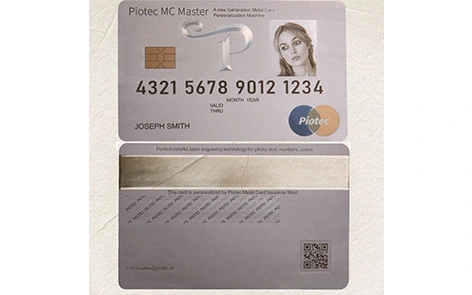
Machine-to-machine connectivity is moving quickly into vehicles, industrial devices, smart meters, wearables, logistics trackers, and eSIM-enabled IoT products. As device volumes grow, chip personalization can no longer rely on slow, semi-manual programming steps. Manufacturers need equipment that can test, encode, mark, verify, reject, and package chips with consistent accuracy.
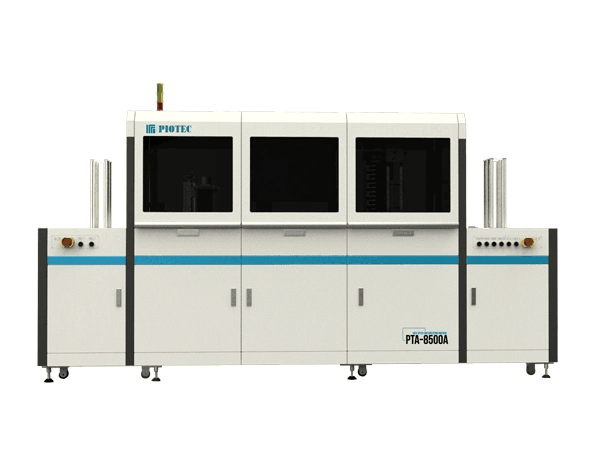
That is where the SCM3000 and SCM4000 M2M chip personalization machines become highly valuable. Built for secure chip programming and high-volume production, they support M2M chips, automotive SE security elements, eSIM chips, and other smart device components in compact packages such as QFN, DFN, VSOP8, and BGA.
M2M and IoT devices often depend on embedded secure elements or eSIM technology to authenticate networks and protect data. The GSMA’s eSIM architecture has helped accelerate remote SIM provisioning across consumer and industrial markets, while secure element technology continues to support trusted identity in connected devices.
For sim card manufacturing companies, mobile operators, automotive electronics suppliers, and smart device OEMs, the challenge is clear: production must be fast, flexible, traceable, and low-defect. A single programming error can create downstream failures in device activation, network access, or customer deployment.
A modern M2M chip personalization line should therefore combine electrical performance testing, chip encoding, surface laser marking, OCR inspection, IC verification, and automatic rejection in one stable workflow.
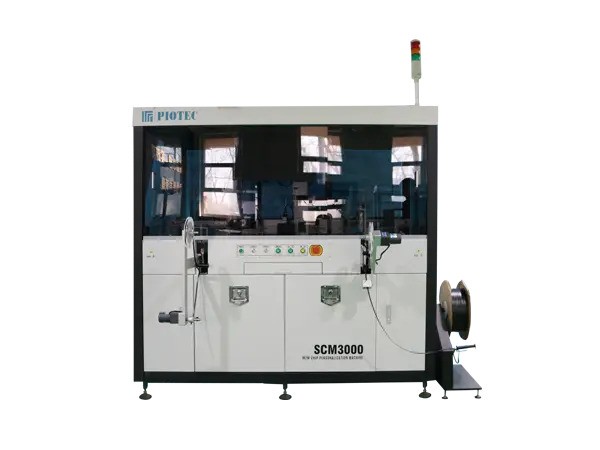
The SCM3000 M2M Chip Personalization Machine is designed for high-speed, secure personalization of M2M chips, eSIM chips, automotive SE chips, and other smart device chips. Since 2017, SCM3000 systems have supported the production of approximately 500 million chips across multiple factories, showing strong field reliability.
One of its biggest advantages is input and output flexibility. The machine supports tray input with up to 20 trays, plus tape input in 12mm as standard, with 8mm, 16mm, and 24mm options available. It is compatible with 1,000-piece and 3,000-piece tape rolls, making it easier to match different packaging and production requirements.
The IC personalization module comes with 16 standard personalization stations using PIOTEC 4-in-1 contact readers, and it can be expanded to 32 stations. It supports ISO7816, serial port, Bluetooth, SPI, and I2C protocols, allowing manufacturers to handle different chip types without constantly changing equipment.
For traceability, SCM3000 includes a 20W fiber laser marking module and OCR verification with a 5-megapixel industrial camera. Its laser system can mark two chips at the same time, improving efficiency. The IC verification module can also read and verify two chips simultaneously, helping ensure 100% data accuracy before output.
In terms of performance, SCM3000 reaches up to 2,500 chips per hour and about 1.3 million chips per month. Its reject rate is below 1/100, downtime within 100 hours is no more than 30 minutes, and the mechanical handling system can process chips as small as 2 × 2mm.
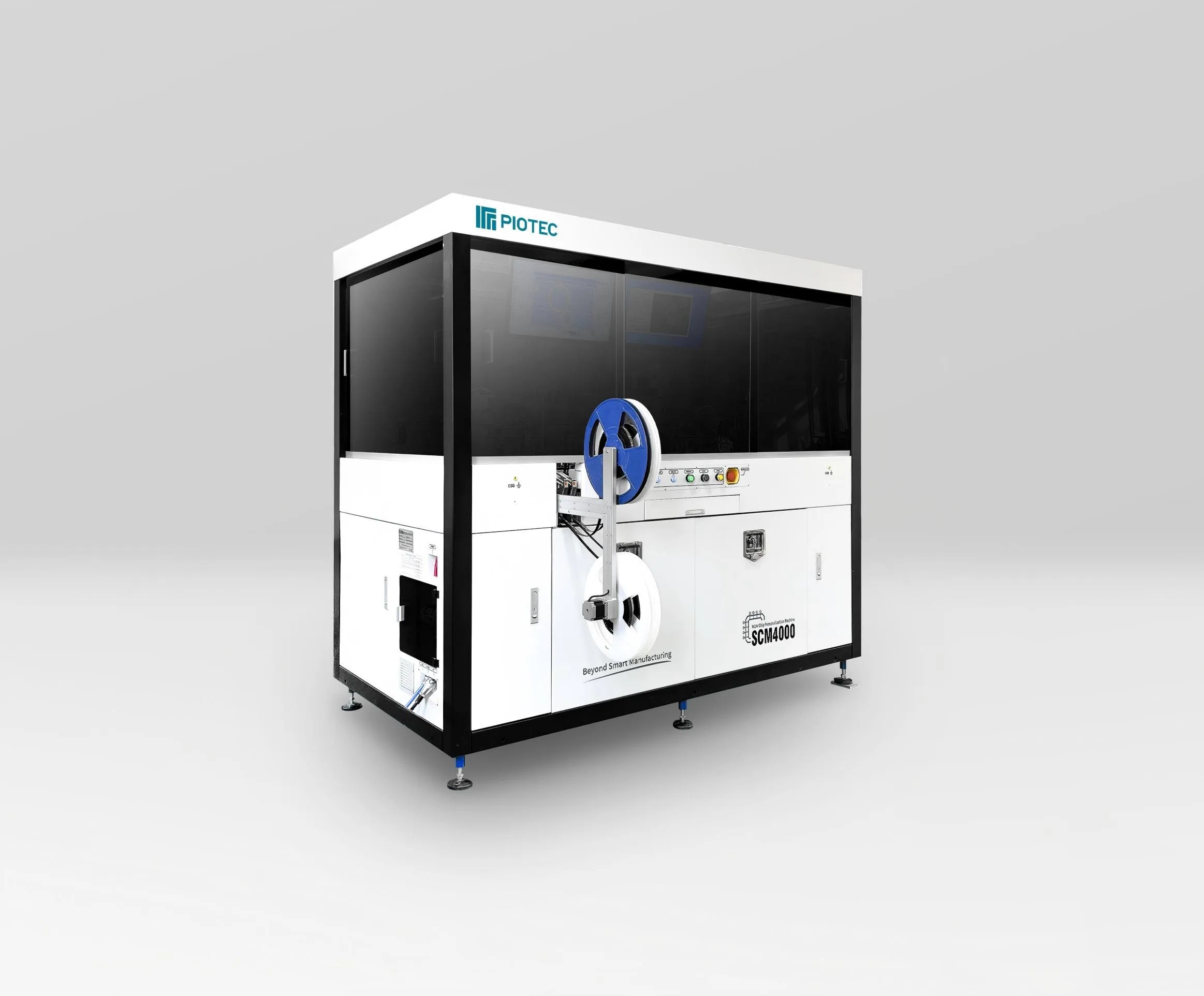
SCM4000 is built for manufacturers that need even higher output. It supports electrical testing, chip encoding, and laser marking for QFN, DFN, BGA, automotive SE, eSIM, and M2M chips.
Compared with SCM3000, SCM4000 offers a stronger standard configuration, including 32 personalization stations with 8 PIOTEC 4-in-1 contact readers. It supports ISO7816, SPI, I2C, and optional multi-protocol readers. The system also includes four IC verification stations, improving inspection capacity during high-speed production.
SCM4000 can reach 4,500 chips per hour and up to 2 million chips per month. It supports tray input and tape input, including 12mm tape as standard and 8mm, 16mm, and 24mm expansion options. It is also compatible with 180mm and 330mm tape rolls.For laser marking, SCM4000 uses a 20W fiber laser and can mark two chips at once. A 5-megapixel industrial camera can identify and verify two chips simultaneously, while real-time surface information display helps operators monitor marking quality online.
Both SCM3000 and SCM4000 help reduce manufacturing risk. Automatic chip orientation, online remaking, OCR inspection, IC verification, and classified rejection boxes reduce material waste and manual handling.
Their modular architecture also supports fast changeover. Dozens of chip specifications can be supported, with switching time under 20 minutes. For manufacturers dealing with mixed orders, shorter changeover means better equipment utilization and faster delivery.
Cost performance is another important advantage. Self-developed core technologies can reduce procurement cost by around 15%, while lower wear and longer service life can reduce maintenance cost by about 20%.
What is M2M chip personalization?
M2M chip personalization is the process of testing, programming, marking, and verifying chips used in IoT, eSIM, automotive, and smart device applications.
What is the difference between SCM3000 and SCM4000?
SCM3000 offers up to 2,500 chips per hour, while SCM4000 reaches up to 4,500 chips per hour with more standard personalization and verification stations.
Can SCM3000 and SCM4000 support eSIM production?
Yes. Both machines support eSIM, M2M chips, automotive SE chips, and other secure smart device chip applications.
Why is laser marking important in chip programming?
Laser marking adds readable surface information for traceability, identification, quality control, and production tracking.
Are these machines suitable for high-volume manufacturing?
Yes. SCM3000 can reach about 1.3 million chips per month, while SCM4000 can reach about 2 million chips per month.

Talk to a Card Personalization Expert